
Shakespeare in Print: Marking the UK National Year of Reading 2026
Updated: Jan 21
2026 has been designated the UK’s National Year of Reading, a nationwide celebration of books, literacy, and reading culture. It is an opportunity not only to read more, but to reflect on how books themselves shape the way texts are understood over time.
Few writers are as closely tied to Britain’s literary identity as William Shakespeare. Over more than four centuries, his works have been edited, translated, published, and studied in many forms. Each generation has encountered Shakespeare differently, shaped by scholarship, language, and cultural priorities.
This article looks at three historical Shakespeare editions recently listed, not as literary criticism, but as examples of how Shakespeare has been presented to readers across time and place.


The first listing is a rare one-volume complete works of William Shakspeare, dating from the 1850s–1860s, a period when Shakespeare was firmly established as the cornerstone of English literary education. The title page deliberately uses the spelling “Shakspeare”, reflecting a scholarly convention rather than error. As outlined by the British Library in its discussion of Shakespeare’s name, spelling variants were common well into the 18th and 19th centuries and were often retained by editors seeking historical fidelity.
Central to this edition’s importance is its reliance on the editorial work of George Steevens (1736–1800), one of the most influential Shakespeare scholars of the 18th century. Steevens devoted much of his career to collating early quartos and folios, correcting textual errors, and annotating Shakespeare’s plays with historical, linguistic, and theatrical insight - work that would shape Shakespeare editing for decades. His significance as a critic and editor is well documented in Shakespearean editorial history.
The title page states that the text is “Accurately Printed from the Text of the Corrected Proof left by the late George Stevens, Esq.” indicating that this volume draws directly from his established scholarly legacy. The inclusion of a memoir by Alexander Chalmers, A.M., further situates the book within a tradition of learned editorial commentary aimed at serious readers.
Published by D. Appleton & Company, 443 & 445 Broadway, New York, this substantial hardcover volume reflects the output of a major 19th-century publishing house.
The volume is illustrated with steel-engraved plates, including a frontispiece portrait of Shakspeare, features associated with higher-quality Victorian editions intended for private libraries rather than casual readership. Though undated, the publisher’s imprint and production style firmly place the book in the mid-19th century, when editors such as Steevens were regarded as authoritative figures whose textual decisions shaped how Shakespeare was read for generations.
As both a reading copy and a historical artefact, this edition embodies Victorian confidence in scholarship, order, and literary canon.

This vintage German-language hardback set, Shakespeare: The Great Dramas (Die Grossen Dramen), reflects Shakespeare’s deep influence beyond Britain. Presented in two volumes, the books feature Shakespeare’s major plays in the German language. As explored in the British Library’s overview of Shakespeare’s reception in Germany, German Romantic thinkers such as Goethe and Schlegel regarded Shakespeare as a model of dramatic genius, while later editors and publishers treated his plays as central to literary education. The continuing importance of Shakespeare within German cultural life is also highlighted by the Goethe-Institut’s work on Shakespeare in German literary culture. Volume I includes Macbeth, Hamlet, King Lear, Romeo and Juliet, Othello, and The Merchant of Venice; Volume II includes Julius Caesar, Henry IV Parts I & II, Henry V, Richard III, and The Tempest.

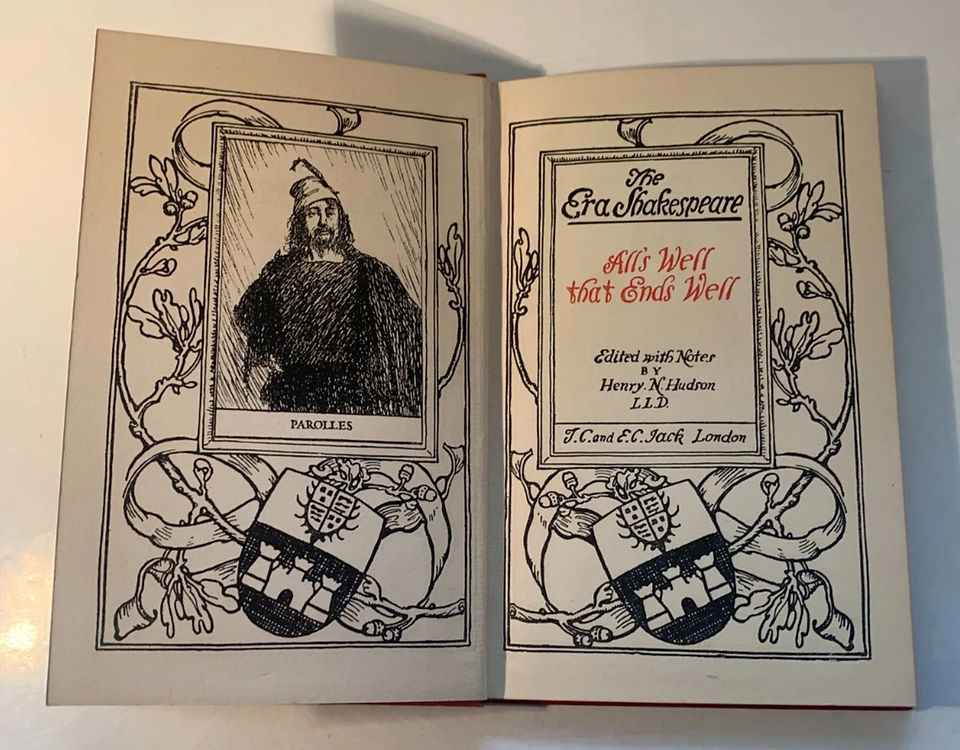
The third title is The Era Shakespeare: All’s Well That Ends Well, edited by Henry Hudson and published in hardback. Hudson was one of the most influential American Shakespeare editors of the 19th century, known for producing editions that combined the play text with extensive explanatory notes and critical commentary.
The Era Shakespeare series was designed to make individual plays accessible to students and serious readers, encouraging close reading rather than casual consumption. Editions of this type reflect a growing emphasis on Shakespeare as a subject of study, performance history, and interpretation, rather than simply a source of entertainment.
All’s Well That Ends Well itself has long posed challenges for readers and critics, a fact discussed by the Folger Shakespeare Library’s overview of All’s Well That Ends Well, which explores the play’s themes, structure, and performance history. Volumes like Hudson’s provided readers with the tools to navigate these complexities, situating the play within its literary and theatrical context.
Together with the other editions discussed here, this volume demonstrates how Shakespeare’s works have been read not only as timeless stories, but as texts requiring interpretation, debate, and scholarly care.
As historical objects, these books demonstrate how Shakespeare was encountered not as a foreign curiosity, but as a foundational dramatic writer whose works were adapted to local language, philosophy, and cultural priorities. They offer a clear example of how books, shaped by their time and place, influence the way texts are read and understood.
For more details about each listing click the images or the buttons above.
To learn more about the National Year of Reading GoAllIn campaign click the link here
About Me
I curate and sell historic and collectible books with an interest in how printed works reflect the culture of their time. My focus is on provenance, condition, and context, helping each book find its next reader or custodian.


Comments